Revenue Plays · Free template
Product Launch Plan: My Free 16-Week Plan to Launch With No Big Ad Budget
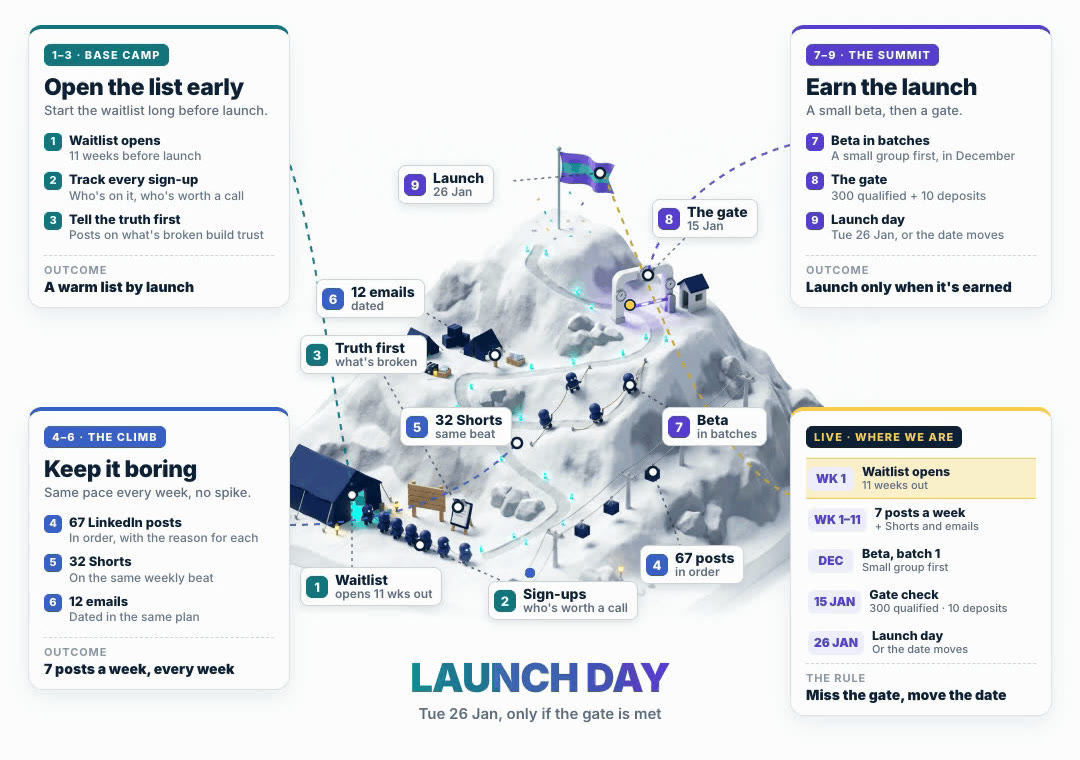
A product launch plan sets out what goes out each week before launch day, who it is for, and the test you must pass before you launch. The free plan on this page is the real 16-week plan for the RevyOps launch: 67 LinkedIn posts in order, 32 Shorts, 12 emails, the map of how each piece feeds the next, and one gate of 300 qualified people and 10 deposits by 15 January. Copy any of it for your own launch.
Ben Reed · · 9 min read
The plan at a glance
| Part | The job | What you get | What it needs |
|---|---|---|---|
| The map | Show how every piece feeds the next | 7 steps from "who it's for" to launch | A written buyer |
| Week by week | Give each week one job | 16 weeks, each with its posts, Shorts and emails | Your launch date |
| The content | Keep the volume steady | 67 LinkedIn posts, 32 Shorts and 12 emails, dated | A LinkedIn profile |
| The waitlist | Show who is worth a call | One record per person, fading points, a fit grade | A CRM or a spreadsheet |
| The gate | Launch only when it's earned | 300 qualified people and 10 deposits by 15 January | One number you commit to |
| Lessons | Save you a month | Six rules, and two things we would change | Nothing |
What is a product launch plan?
A product launch plan is a dated list of the posts, emails and checks you will do before launch day, with one clear test that says you are ready. It says who the launch is for and what goes out each week. A dated plan is much harder to skip than a goal, and a bad week shows up early.
| Product launch plan | Go-to-market plan | Marketing plan | |
|---|---|---|---|
| Time span | Weeks before and after one launch | The first year or more | A quarter or a year |
| What it sets | Each post, email and date | Who you sell to, price, channels | Budget and campaigns |
| Done when | The launch has happened | You sell the same way every month | The period ends |
A launch plan sits inside a go-to-market plan and covers the launch itself.
What's in the plan
The map: how every piece feeds the next
Read it top to bottom. Content makes people engage, what they do lands in one record per person, and the record picks the route. Every route ends at the waitlist.
- Know who it's for. Write down who you sell to and who you never sell to, then load lists of people who fit into your CRM (the system that holds a record for each person).
- Make content. 7 pieces a week. LinkedIn first, then Instagram, Facebook, X, YouTube and a daily email.
- Catch every touch. Comments, likes, site visits, video views, connections and DMs all go into the CRM.
- One record per person. Log what they did, add points that fade, rate the fit from 1 to 5.
- Pick the route. Each person lands on one list with one next step.
- The waitlist. Every link you post or send points here.
- Beta, then launch. Small batches first, then everyone.
16 weeks, one job each
Each week has one job, and every piece that week serves it.
| Week | Phase | The job |
|---|---|---|
| 1 | Waitlist | Ask if anyone wants it. Open the waitlist. |
| 2 | Waitlist | Show the whole plan and the first proof. |
| 3 | Waitlist | Tell the hard story. Say what the idea is. |
| 4 | Waitlist | Show how I've launched before, and the AI on the team. |
| 5 | Beta | Admit what broke. Answer the pricing questions. |
| 6 | Beta | Give the plan away. Show who's signing up. |
| 7 | Beta | Give away free skills in the quiet week. |
| 8 | Beta | Share the real numbers. Look ahead to 2027. |
| 9 | Run-up | Open the beta wider. |
| 10 | Run-up | Give away the outbound system. Check the gate on 15 Jan. |
| 11 | Run-up | Beta stories. The last push before launch. |
| 12 | Launch | Launch on Tuesday. Show it working live. |
| 13 | After launch | Share what people said. Answer the critics. |
| 14 | After launch | Talk to founders. Show a guest build. |
| 15 | After launch | Say where the market is going. |
| 16 | After launch | A live debate and the full launch numbers. |
67 posts, 32 Shorts, 12 emails
The volume stays steady on purpose. Weeks 1 to 12 each have 5 posts and 2 Shorts, launch week included, so there is no big spike. Of the 67 LinkedIn posts, 37 are image posts, 26 are text, and the rest are a carousel, a video and two posts with several images. An email goes out most weeks, from "I'm building a CRM (I know)" to "The full launch numbers".
The posts mix how-tos with the founder's story and the odd giveaway.
The waitlist: who's worth a call
A waitlist is only useful if you know who is on it. The plan's system:
- One person, one record. A sign-up, a comment and a site visit from one person join up.
- Points that fade. Every comment, visit or reply adds points. Old points count for less each week.
- Fit, 1 to 5. A 5 is the exact buyer. A 1 is not a fit, however keen.
- Lists do the work. A good fit who is engaging now lands on a list, and the list starts the next step on its own.
- The founder calls every sign-up. It's the best research we do.
- One number. How many strangers get a real result on their own, with no help.
The four routes
| Route | Who | What happens |
|---|---|---|
| Never | Bad fits and anyone who said no | Out for good |
| Warm up | Not a fit yet, or quiet | No messages. They see posts and a few ads. A good fit who starts engaging moves up. |
| Reach out | Good fit, engaging now | A short LinkedIn message with a personal link to the waitlist |
| Send it | Asked for a giveaway | The link goes out. If they haven't joined in 2 days, one polite follow-up and an ad. |
One gate before launch
300 qualified people on the waitlist and 10 deposits by 15 January. Short of that, the launch date moves. Beta runs in small batches from December, and everyone else gets in on Tuesday 26 January.
Six rules, and what we'd change
- Start the list earlier than you think. Our waitlist opens 11 weeks before launch. The launch I studied ran about 25.
- Tell the truth first. A post about what's broken builds more trust than a feature post.
- Let people in a few at a time. A small beta teaches more than a big launch.
- Keep the volume boring. 7 pieces a week up to launch, no spike on launch week.
- Pick one number and watch it.
- Don't split your attention. We skip cold calling and conference booths.
If we started over, we would open the waitlist sooner and get the inbox working inside the CRM before the beta.
See it work
Three samples from the plan.
One week, in full (week 6, 14 to 20 December, from the plan):
Job: Give the plan away. Show who's signing up.
Posts: Steal my launch plan · Waitlist discovery · How did you get in · What I hate · GTM plays
Shorts: I read every waitlist sign-up · 10 things I hate about my own CRM
Email: 10 things I hate about my CRM
The first week of posts (from the plan):
| Date | Post | Format |
|---|---|---|
| 9 Nov | Should I build it? | Text |
| 10 Nov | Half my buyers stopped counting | Image |
| 11 Nov | Why now | Carousel |
| 12 Nov | My record | Text |
| 13 Nov | Ask the crowd | Image |
One person through the record (a made-up example):
Comments on a post (points added) → visits the site twice (more points) → fit graded 4 → lands on "Reach out" → gets a short LinkedIn message with a personal waitlist link → signs up → gets a call.
How to use the plan
- Get the plan. Get the launch plan free. It opens on the next page as a web page.
- Start with the map. Write down who you sell to and who you never sell to, before any post.
- Copy the 16 weeks. Change the dates to yours and keep one job per week.
- Set your gate. One number, one date, and what moves if you miss it.
- Review every Friday. Check who engaged and call the best fits.
Make it yours
You can change any part. A shorter launch can cut the weeks after launch, and a team with no video can swap Shorts for image posts. The routes and the gate work with any CRM or a spreadsheet. Copy any of it for your own launch.
Why I built it
I'm launching RevyOps, an AI CRM for Claude, without a big ad budget or a sales team. I studied one founder's launch post by post, wrote down what I'd steal and what I'd skip, then turned it into dates. Then I made the plan public so it has to hold up. I've spent 12 years building B2B sales teams at five software companies, and one of them sold for $6 million.
Questions
What should a product launch plan include?
A product launch plan should include who it is for, a dated list of every post, email and video, how you track who engages, and one test that says you are ready.
How long should a product launch plan be?
Plan at least 11 weeks before launch and a few weeks after. The RevyOps plan runs 16 weeks: 11 weeks of run-up, launch week, then 4 weeks after. The launch I studied opened its waitlist about 25 weeks out.
How do you launch a product with no big ad budget?
Lead with one main channel (LinkedIn here) and post on it every week, then repeat the pieces on your other channels. Message the good fits who engage. Spend a little on ads, mostly to show posts again to people who already visited your site.
What should I write when launching a new product?
Mix how-tos with your own story, including what broke, and add a giveaway now and then. The plan has 67 posts with working titles to copy.
Is the launch plan free?
Yes. Enter your email and the plan opens on the next page. Copy any of it.
Get the 16-week launch plan free
Every post, Short and email, dated. The plan opens on the next page.